Morimoto's: Kicking it Iron Chef Stylie
We were lucky enough to eat at Iron Chef Morimoto’s namesake restaurant in Philly the month it opened, thanks to my wife’s cousin getting a reservation. I mostly wrote this on the plane coming home and was one of the first reviews of the restaurant on the internet.
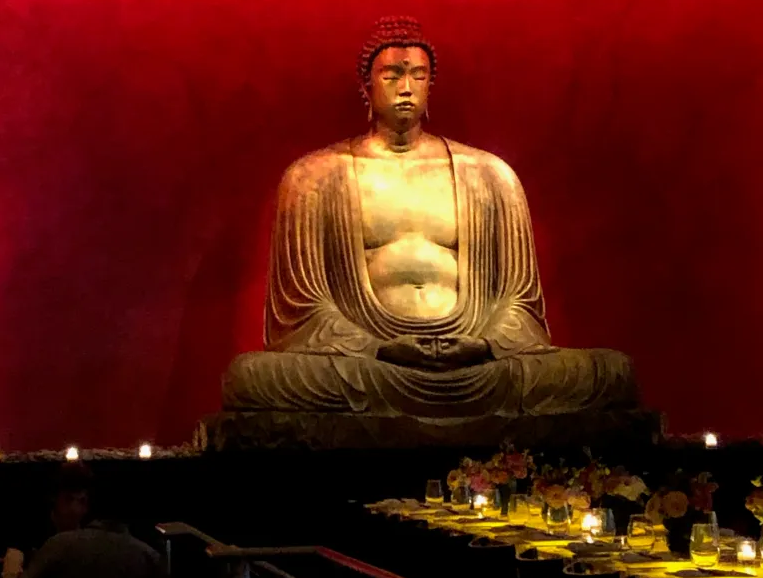
We met Ryan and Alice a couple blocks away from Morimoto’s at Buddakan, also owned by Stephen Starr who funded Morimoto’s. Buddakan was a good intro: 45-foot-high ceilings, high-tech zen (silver painted columns, woven aluminum and mahogany seats) and the eponymous 20-foot tall golden Buddha presiding over the whole scene.
We walked over to Morimoto’s. The exterior wasn’t all that exciting, but it did share the front facade with a kung-fu school. I had visions of Morimoto training a cadre of killer sous-chefs to take care of that damned Bobby Flay once and for all.
The restaurant has a low-ceilinged entry with a gigantic back-lit woman’s face on the left. The dining room is open, narrow, deep, with a very high ceiling made up of waves of bamboo strips, bamboo flooring and pale green walls. The overall feel is an Asian post-modern screening room.
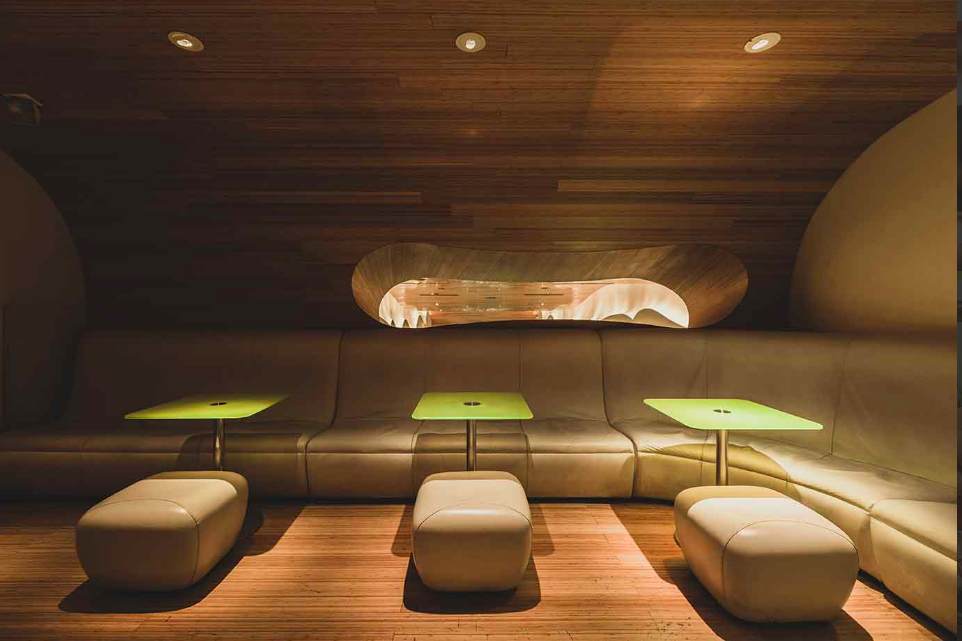
The lounge upstairs — where the projection room would be — is womb-like: low-ceilinged, paneled in bamboo, with low white pleather wrap-around couches and a itty-bitty bar tucked in the corner. An 8-foot wide blob-shaped hole in the wall let us look out over the whole dining room. In keeping with the screening room metaphor, Morimoto’s domain — the kitchen and sushi bar — is in the back of the restaurant, where the screen would be.
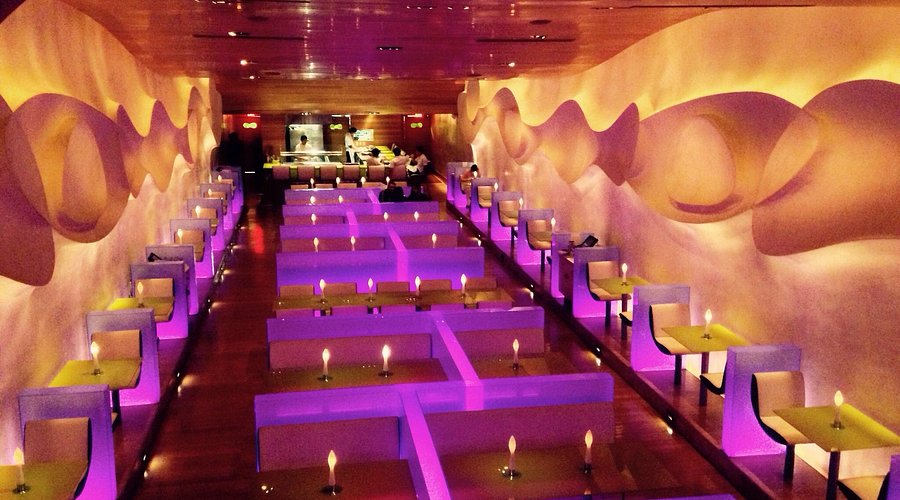
The restaurant has wide tables down the center seating eight, with rocket-age bench seats covered in the same white pleather as the lounge’s couches. Tempered glass walls separate the tables and are internally lit with continuously cycling color. The walls have large wavy organic-shaped sculpture picked out with halogen spotlights that dim and brighten, slowly changing the shadows and wall colors. The light lime green glass tabletops have built-in white lamps that seemed frighteningly phallic to us. The tables were set with thick mahogany chopsticks set on small river rocks. We would later discover that the downstairs bathroom continued the design trends with bamboo panels, flat black river rock floors and mysterious infrared hand dryers inset in the walls behind blob-shaped holes.
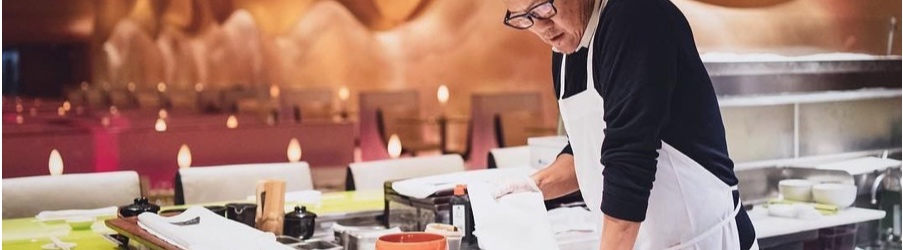
We were surprised to see Morimoto appear at the waiters’ station near our table, as his website had said he would be in Hawaii. He smiled and nodded to us as he walked back to the kitchen area. He made several trips into the dining room while we were eating and was quite chatty. We said “hi” and I told him that our meal was amazing, but we were somewhat awestruck and determined not to act like Iron Chef geeks, so we pretty much left it at that.
The menu had surprisingly few sakes (five or six), though the two we tried were very good and our attitudinal server was actually pretty knowledgeable about them. The first sake, sho chiku bai organic nama, was served cold in its bottle; the second, junmai ginjo morimoto, was served in a bamboo carafe that Alice termed the sake bong.
The first page of the menu was all appetizers, most of which sounded very interesting. The second page was soup, salad and noodles with ten or so entrées. The back two pages were all sushi. After much discussion we decided on the seven-course Morimoto Omakase or chef’s choice (available at $80, $100, and $120 — we chose the $100), a sushi chef’s choice (available at $30, $50, $70 — we picked the $50 and given the choice opted for quantity over quality, as we assumed the quality would be high regardless), we added an unagi sushi for Lori, a few appetizers and an entrée of ishi yaki buri bop — hamachi cooked at the table over hot river stones.
We told the server to bring stuff out when it comes and not bother trying to stage things to arrive in courses. A wise choice that seemed to help his attitude out a lot (he became peppier as the meal went on; Lori and Alice thought he might have had a little pick-me-up in the back mid-meal).
The first thing out was course one of the chef’s choice: toro (fatty tuna) tartar on top of crispy, caramelized onions, molded into a tight cylinder with a teaspoon of caviar on top (given how much caviar was sprinkled on top of things, I think Morimoto must have caviar in a shaker in the back). This was sitting in a soy/shoyu sauce, served with fresh coarsely ground Most sushi bars use a paste of horseradish and mustard powder dyed green. Real wasabi is grated from the fresh rhizome of Wasabia japonica — sweeter, more complex, and the heat dissipates quickly instead of burning. — the real stuff, sweeter and stronger than the typical sushi bar mustard/horseradish paste. It was pretty amazing, quite a complex combination of flavors. No one wanted to fight me for the juice in the bottom of the cup, which I mopped up with radish threads.
Our Morimoto tempura appetizer came out next: very light tempura, big prawns, oyster mushrooms and some other vegetables, individually skewered and served in a tepee over a gorgonzola crème sauce. I had half of a giant mushroom and all the prawn heads (silly round-eyes didn’t want to eat the good stuff). Not very Japanese, but comfort food of the first stripe.
The drunken shrimp appetizer came out next — four huge prawns, steamed in sake, sitting on top of a grilled corn tortilla that had swollen from the steam, served in the bamboo steamer on a big platter, with a high-end soy-shoyu dipping sauce. Everyone loved this; it was surprisingly rich but a bit cold by the time I got to it since the zensai sakezuki (“Japanese antipasto”) came out right behind it and took my full attention.
This was the first real Morimoto presentation item: a wooden bucket filled with ice, with palm leaves, a rolled-up hand-woven mat of herbs, a purple orchid, and chunks of lemon grass and black bamboo surrounding deep glass jars holding three items: “whitefish” and spinach over shredded radish with a sweet sake sauce; tataki beef with ginger sauce; and a big prawn with steamed Japanese turnip sitting in a sweet rice vinaigrette with shiso. Beautiful, complex, elegant and well-balanced — this was Iron Chef cuisine.
The next dish from the omakase seemed quite simple: sashimi wrapped around Sea urchin roe. Notoriously polarizing — when it's bad, it tastes like low tide. When it's fresh, it's rich and briny and unlike anything else. in a “hot oil” sauce. Unbelievable. The warm uni had a texture like a raw oyster, much different than when I’ve had it before (I assume fresh, not frozen). The whole thing just exploded in my mouth. Some sort of greens lined the bottom of the plate and was stellar for wiping up the hot oil sauce. The best dish of the night for me.
The gigantic sushi platter came out with tamago (which has always seemed too boring to order, although this tasted more like pound cake than just eggs), wonderful unagi and anago, buttery mackerel, toro, hamachi, salmon, sardines, and some pale silvery fish that was very good which our server proclaimed quite rare. All the sushi was perfect, though nothing was super interesting. Soto, in Atlanta, has comparable quality, though I wonder what Morimoto’s “quality” version would have been like. A bit later our server brought us some bonus sushi — another half dozen pieces.
After the sushi we got the perfect post-sushi omakase dish: wasabi and shiso sorbet. The Iron Chefs seem to delight in making whacked-out ice creams, but this was very light, slightly sweet with just a hint of heat. An excellent way to clear the palate.
The next omakase dish — steamed cod with peppers in a dashi sauce — was nice comfort food, but somewhat boring after what had preceded it.
The next omakase was True Kobe beef comes exclusively from Tajima-strain Wagyu cattle raised in Hyogo Prefecture, Japan. In 2001 it was nearly impossible to get in the US — what you usually got was domestic Wagyu crossbreeds marketed as Kobe-style. in a thin miso sauce, served with a scary knife that looked like it had been stolen from an operating room and was completely unneeded, as the beef fell apart on the fork. Far and away the best beef I’ve ever tasted. The cooking time and temperature must be very carefully managed to keep such a delicate piece of beef so succulent.
Our ishi yaki entrée arrived and was prepared at the table. Not the theatrical presentation the menu had us envisioning — the large thick earthenware bowl full of rice, thin sliced mushrooms, vegetables and raw hamachi was brought to the table on a platter covered with rock salt. Our server poured on about six ounces of sauce which instantly steamed and hissed when it hit the apparently fresh-from-the-oven bowl. He stirred the ingredients with chopsticks as the hamachi lightly cooked (somewhere between rare and raw). High-end comfort food, but not particularly exciting.
Dessert was a pumpkin cake — actually a 4-inch tall, 1-inch wide cylinder — with dollops of what tasted like goat milk yogurt lightly sprinkled with red pepper, and “tofu cheesecake” with mango. Both were outstanding: light and not too sweet, they complemented each other perfectly to end the meal.